Round Summary
So you’ve played a few rounds on Roundabout and you’re ready to dive into some stats. The best place to start is on the Round Summary page. This page shows you at a glance what you did well and what you poorly in your last round. Easily see what part of your game you gained strokes and what part you lost strokes to help pinpoint what you need to work on. From the Roundabout home screen, tap REVIEW on the bottom toolbar and then choose the round you’re looking at. When you click on a round, you’ll see the option to open the round summary shown below.
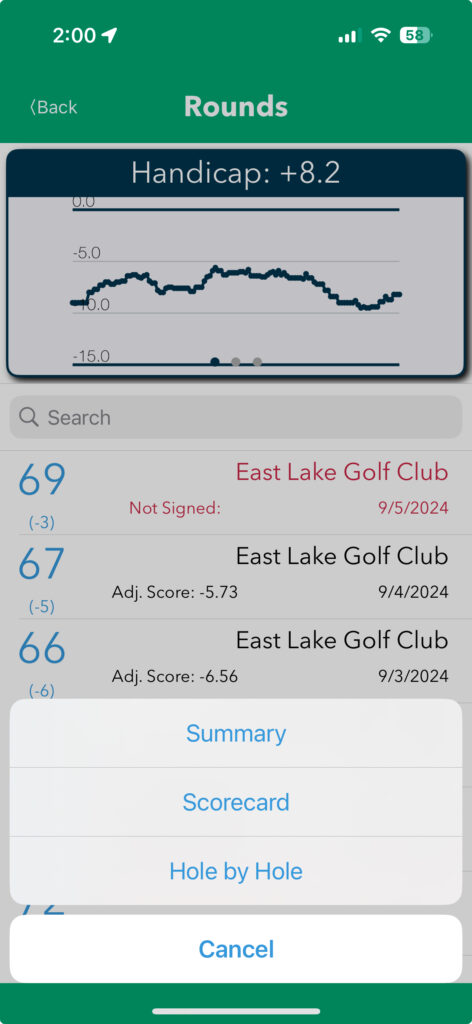
After choosing Summary, scrolling through the screens show more and more information to help break down your game.
Traditional
In this round, the player carded an even-par 72 with balanced play across key areas. Off the tee, the player averaged 169 yards and reached a long drive of 290 yards, hitting just over half the fairways (53.8%). Approach play was steady with 12 of 18 greens in regulation (66.7%), creating plenty of birdie chances. Around the greens, scrambling proved more challenging at 40% (4 of 10). On the greens, however, the player excelled, needing only 29 putts. Overall, the round shows strong ball striking and putting, with the main improvement opportunity being to convert more up-and-downs when greens are missed.

Strokes Gained
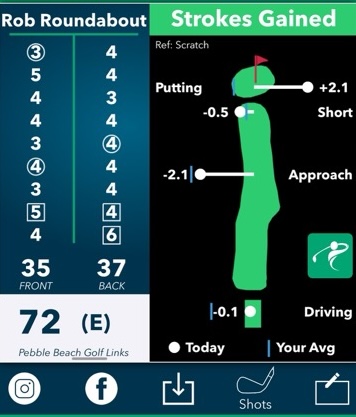
Swiping to the strokes gained summary shows clear strengths and weaknesses across the player’s different strokes-gained categories. Driving and approach shots appear to be costing them the most strokes compared to benchmark players, while their short game and putting are holding up more steadily. This suggests that their focus should be on improving consistency and accuracy off the tee and tightening up their approach shots into greens. By sharpening those areas, they will set themselves up for easier short-game opportunities and fewer pressure putts, leading to lower scores overall.
Driving
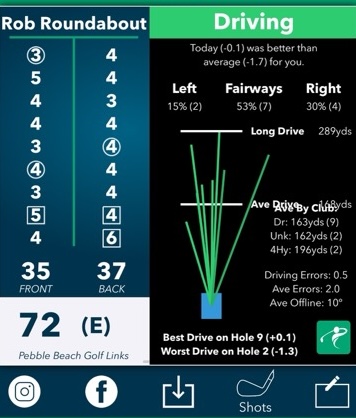
This round summary shows that the player’s driving was slightly better than their personal average, with a strokes gained of -0.1 versus their usual -1.7. They hit 53% of fairways, but about 45% of their drives missed left or right, with an average miss of 10 yards offline. Their long drive reached 289 yards, but their average driving distance was only 168 yards, suggesting inconsistency across attempts. The data shows that their biggest opportunity for improvement is increasing both accuracy and consistency off the tee—reducing those wide misses will set up better approach shots and lower scores overall.
Short Game
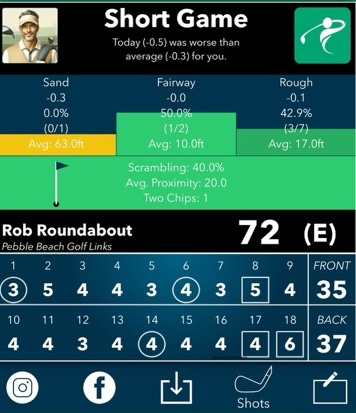
In this round, the player’s short game cost strokes compared to their usual performance, finishing at -0.5 versus an average of -0.3. From the sand, the player failed to get up-and-down and left shots an average of 63 feet from the hole. Fairway chips were more accurate, averaging 10 feet, while rough shots left longer putts at 17 feet. With a scrambling rate of just 40% and one two-chip, the data suggests the player would benefit most from sharpening consistency around the greens, especially out of bunkers and rough, to leave closer putts and convert more pars.
Putting
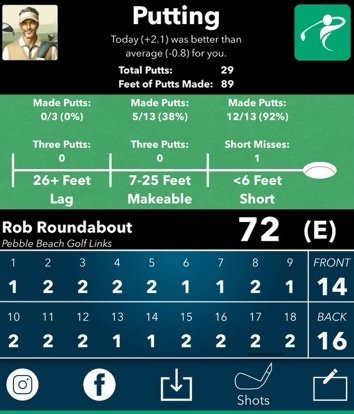
In this round, the player’s putting stood out as a strength, gaining +2.1 strokes compared to an average of -0.8. The player needed only 29 putts and converted a total of 89 feet of putts. Performance was excellent inside six feet, making 92% of attempts, and solid from mid-range (38% from 7–25 feet), with just one short miss and no three-putts recorded. Although no long putts over 26 feet dropped, the player’s consistency on short and makeable putts anchored the round and turned putting into a clear advantage.
Approach
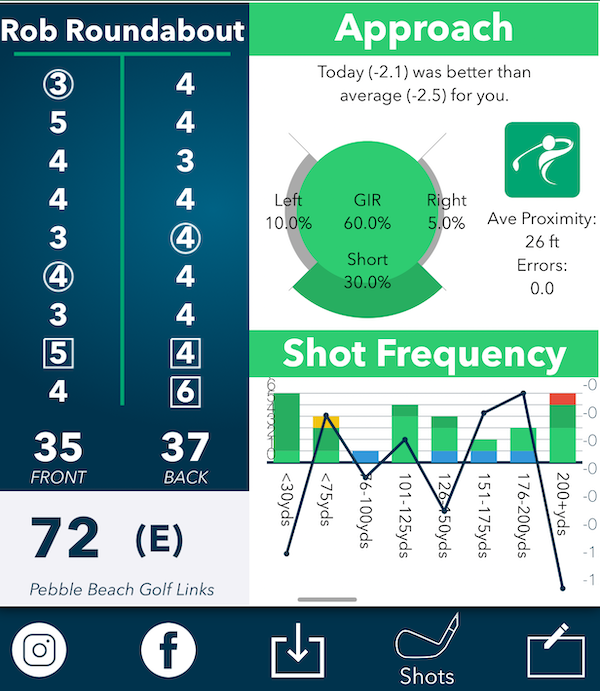
In this round, the player’s approach game was slightly better than their personal average, finishing at -2.1 strokes gained compared to a typical -2.5. They hit 60% of greens in regulation, with most misses coming up short (30%) and fewer going left (10%) or right (5%). Average proximity on approach shots was 26 feet, and there were no major errors recorded. While overall performance was an improvement relative to the player’s baseline, the data shows that leaving shots short remains the biggest challenge, suggesting a focus on distance control and confidence in club selection.
Potential
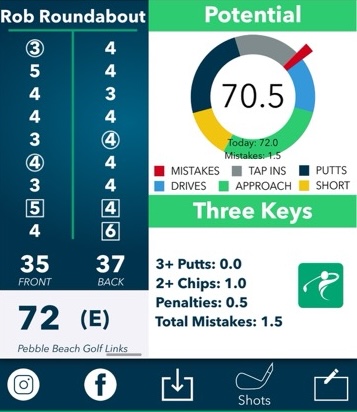
In this round, the player posted an even-par 72 with a potential score of 70.5, showing there were opportunities to save a stroke or two. The breakdown highlights 1.5 total mistakes, including one instance of needing multiple chips and half a penalty stroke. Importantly, the player avoided any three-putts, which kept putting as a net positive area of performance. The data suggests that the main opportunities for improvement lie in reducing short-game mistakes and avoiding penalties, as cleaning up these areas could realistically turn solid rounds into under-par scores.